
The 5-Foot Rule: Why Your Trees Should Never Touch Your Block Wall
If Your Yard Has a Block Wall, You Are Not Alone
Walk through almost any neighborhood in the Las Vegas Valley and you will see the same thing lining nearly every backyard: a CMU block wall. From Summerlin to Henderson to the older neighborhoods near downtown, the stucco-coated block wall is about as close to universal as landscaping gets here.
What is almost just as universal? Trees planted way too close to it. Not a few inches off here and there — we mean right up against the wall, practically leaning on it, with root balls sitting inches from a footing that was never designed to handle what happens next.
The Tract Home Problem
Most of the time, this mistake isn't the homeowner's fault at all — it starts at new construction. Production builders and their general contractors are focused on one thing at close-out: making the yard look finished and green for the buyer walk. Nobody on that crew is thinking about what a root system looks like ten years down the road.
So a tree goes into whatever narrow side yard or planter strip is left over, often just a foot or two from the block wall. And too often, it's a fast-growing, deep-and-wide-rooted species — Palo Verde and every type of Mesquite are the two we see the most — chosen because they fill in quickly and look great on day one.
Palo Verdes and Mesquites are genuinely great desert trees. The problem was never the species — it's where they got planted. Give either one the room its root system actually needs, and it's a low-water, high-payoff addition to a Las Vegas yard. Plant it a foot from your wall, and you've built yourself a problem on a timer.
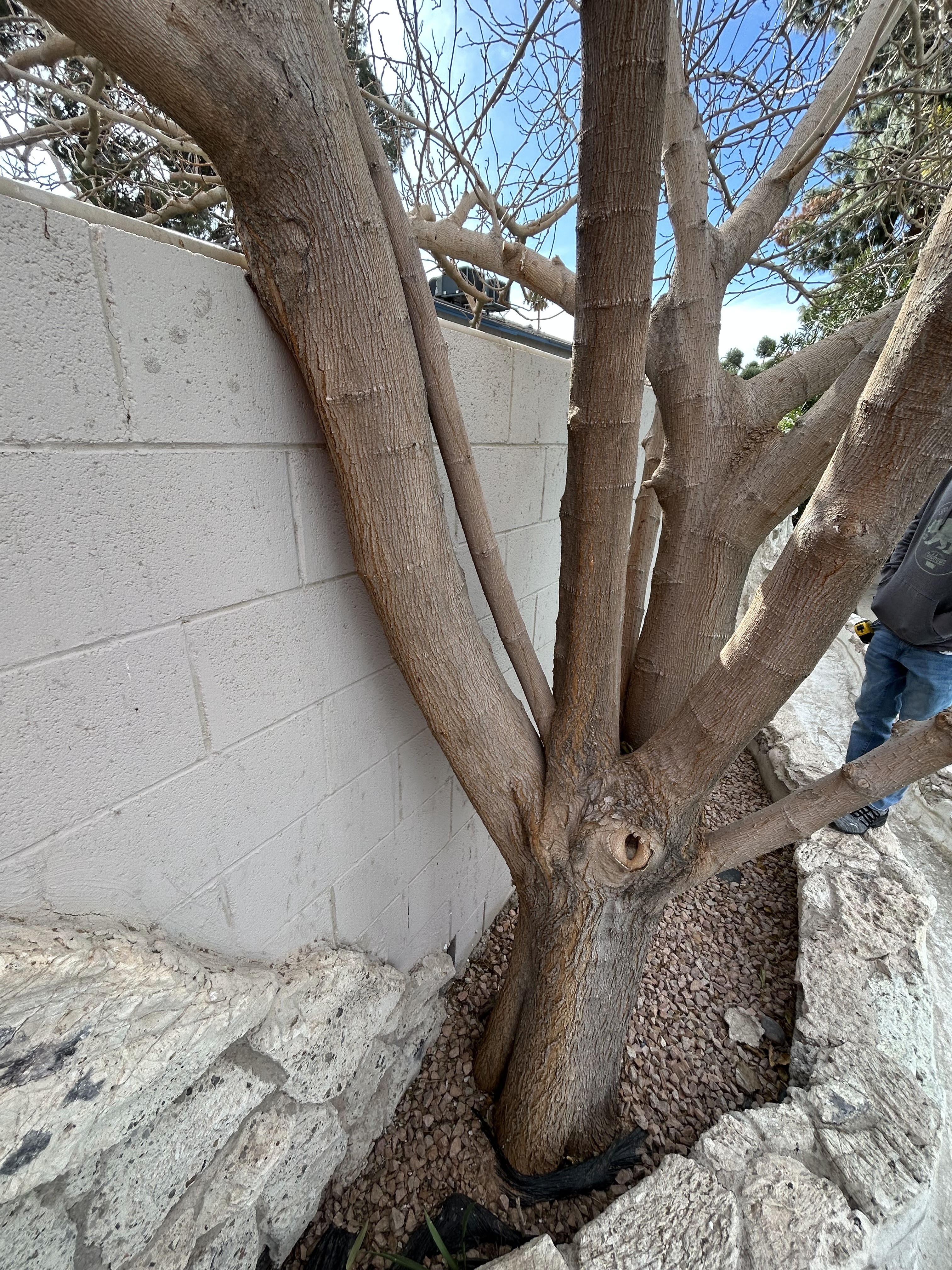
How This Turns Into a Homeowner's Nightmare
This is one of the single most common calls we get from homeowners all over the valley — and by the time we're called, the damage is already visible.
Cracked block & separated mortar joints
As roots thicken over the years, lateral pressure builds against the footing until the wall itself starts to give — stair-step cracks through the mortar joints are the classic sign.
Leaning or shifted wall sections
A block wall footing is shallow by design. It was never engineered to fight a root system — once the roots win that battle, entire sections start to lean or heave out of line.
Heaved caps, pavers & flatwork
It is rarely just the wall. Roots traveling under a paver patio, a walkway, or a concrete cap will lift and crack whatever sits above them, sometimes yards away from the trunk.
Expensive, disruptive fixes later
Catching this early might mean a root barrier. Catching it late usually means tearing out block wall, hardscape, or the tree itself — all avoidable with the right planting distance from day one.
How Much Space Does a Tree Actually Need?
Five feet is the floor, not the ceiling. The bigger and more aggressive the root system, the more room you want between the trunk and the wall footing.
Absolute minimum distance from any block wall footing for even the smallest ornamental tree.
We Think About This Before a Single Tree Goes in the Ground
When we design a landscape, tree placement isn't an afterthought — it's part of the plan from the very first sketch. We look at your walls, your footings, your hardscape, and your irrigation lines, and we place every tree where its root system can actually grow without picking a fight with your property. That's the difference between a yard that looks good on install day and one that still looks good in ten years.
Already have a tree that's too close to your wall? That's no problem for us either. We evaluate existing problem trees on-site and give you a straight, honest recommendation — whether that's a root barrier, selective root management, or relocating the tree before the damage gets worse.
Don't Let a Tree Take Down Your Wall
If you need a contractor you can trust to get tree placement right the first time — or fix a problem someone else created — give us a call. Free on-site estimates for all landscape design and installation projects.